
AI Agents for ERP: How Autonomous AI Is Transforming Finance & Operations in 2026
Introduction: ERP Is Becoming More Intelligent
ERP systems have always been the backbone of enterprise operations.
They manage financial transactions, procurement, inventory, customer orders, suppliers, and operational data.
But employees still spend hours reviewing transactions, investigating exceptions, reconciling records, following up with suppliers, and moving information between systems.
AI agents are changing this model.
Instead of simply answering questions, AI agents can understand business context, recommend actions, execute authorized tasks, and coordinate workflows.
The result is a shift from:
System of Record → System of Intelligence → System of Action
What Are AI Agents for ERP?
An AI agent for ERP is an AI-powered system designed to understand a business task, reason over relevant information, and take authorized actions within a defined workflow.
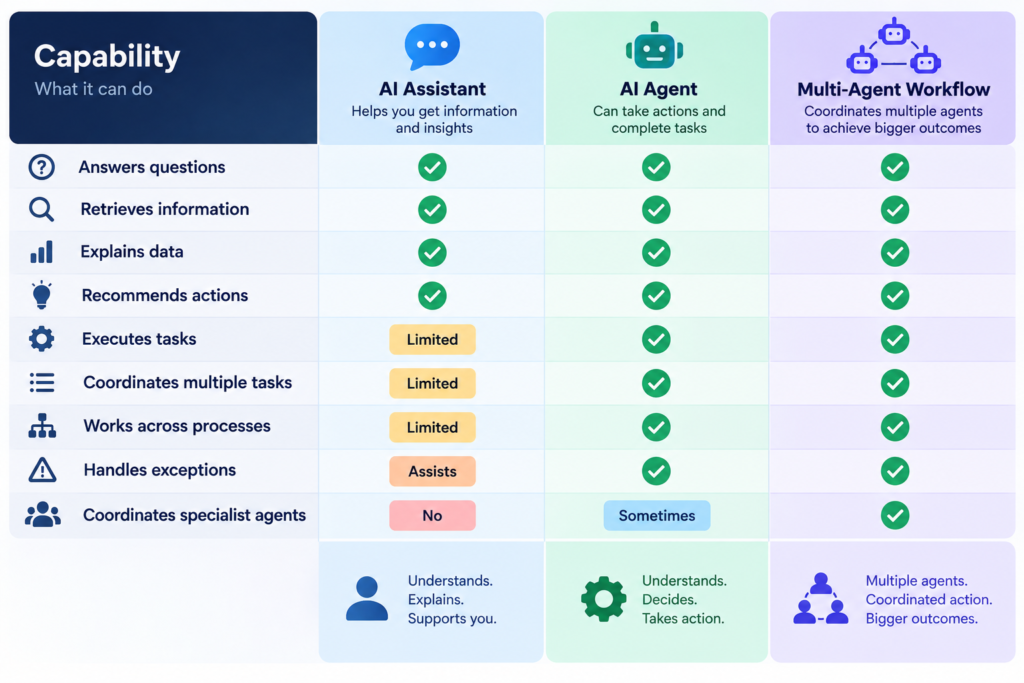
A traditional AI assistant might answer:
“Which invoices are overdue?”
An AI agent can potentially go further:
Identify overdue invoices → analyze payment history → prioritize accounts → recommend actions → prepare communications → update the workflow.
The key difference is action.
AI Assistant vs AI Agent vs Multi-Agent Workflow
7 ERP Processes AI Agents Can Transform
1. Accounts Payable
AI agents can help receive invoices, extract information, match invoices with purchase orders and receipts, detect exceptions, and route approvals.
Result: Faster invoice processing with less manual work.
2. Invoice Matching
An AI agent can compare:
Invoice + Purchase Order + Goods Receipt
and identify:
- Quantity differences
- Price mismatches
- Duplicate invoices
- Missing receipts
- Unusual transactions
High-confidence invoices can move automatically, while exceptions go to the appropriate person.
3. Reconciliation
AI agents can compare transactions, identify unmatched records, investigate discrepancies, and recommend resolutions.
Instead of manually reviewing every transaction:
AI identifies what actually needs attention.
4. Procurement
AI agents can monitor purchase requests, compare suppliers, follow up on purchase orders, track delays, and recommend actions.
This can turn procurement from a reactive process into a more proactive workflow.
5. Sales Order Automation
An AI agent can potentially transform:
Customer Email → Data Extraction → Validation → Inventory Check → Sales Order → ERP
This reduces manual effort involved in converting unstructured customer requests into ERP transactions.
6. Supply Chain Exception Management
AI agents can continuously monitor:
- Supplier delays
- Inventory shortages
- Delivery issues
- Demand changes
- Production disruptions
Instead of simply generating alerts, AI can help identify, prioritize, and recommend responses.
7. Financial Planning & Analysis
AI agents can analyze financial data, identify variances, explain changes, generate forecasts, and support scenario analysis.
This moves FP&A from:
Report preparation → Continuous financial intelligence
AI Agents vs Traditional Automation
Traditional ERP automation generally follows predefined rules.
If X happens → Do Y.
AI agents can work with more context:
Understand → Reason → Decide → Act → Verify
This makes them useful for processes where information is varied, exceptions are common, and multiple steps need to be coordinated.
However, traditional automation remains valuable for highly predictable processes.
The opportunity is to combine both.
Why Human-in-the-Loop Matters
AI should not automatically approve every financial or operational decision.

A practical model is:

High confidence + low risk

Automate

Medium confidence

AI recommends → Human reviews

High risk

Human approval required

This allows enterprises to gain automation benefits while maintaining appropriate controls.
AI Agents Across ERP Platforms
The move toward agentic ERP is happening across major enterprise platforms.
SAP S/4HANA
SAP is expanding specialized AI agents and assistants across areas such as finance, supply chain, procurement, and customer experience.
Oracle Fusion Cloud ERP
Oracle is introducing agentic capabilities across finance and supply chain, including specialized agents for areas such as payables and planning.
Microsoft Dynamics 365
Microsoft is expanding AI agents across ERP processes including reconciliation, supplier communication, and other business workflows.
JD Edwards and Other ERPs
Organizations using established ERP platforms can explore AI as an intelligence and orchestration layer around their existing systems.
Where Should You Start?
Don’t try to automate everything at once.
Start with a process that has:
- High transaction volume
- Significant manual effort
- Clear business rules
- Frequent exceptions
- Measurable outcomes
Good starting points include:
Invoice Matching | Reconciliation | Procurement | Exception Management | Sales Order Automation
Measure:
- Processing time
- Manual effort
- Error rate
- Exception resolution time
- Automation rate
- Cost per transaction
Conclusion
The next generation of ERP isn’t just about storing business information.
It’s about using that information to understand, decide, and act.
AI agents can help organizations move from repetitive manual workflows toward intelligent, exception-driven operations while keeping humans involved where judgment matters.
The future of ERP is not:
People vs AI
It is:
People + ERP + AI + Agents
working together to create smarter enterprise operations.
